What Is Charades? Meaning, Rules and How to Play It Free
What is charades? It’s a classic party guessing game: one player acts out a word, phrase or title without speaking, and their team tries to guess it before time runs out. It began as a spoken and written word riddle, became an acted parlour game in British and European homes, and is now played at family gatherings, in classrooms and as a phone-on-the-forehead game.
What is charades, and what does the word mean?
The word has two meanings in English:
- The game: a guessing game where players act out words silently. It is usually written in the plural, “charades”, and treated as singular: “Charades is my favourite game.”
- A pretence: in everyday speech, “a charade” is something fake that everyone can see through, as in “the meeting was just a charade.”
Both meanings come from the same root: the idea of performing something so others can work out what is really going on.
Where did charades come from?
Charades started as a riddle rather than an acting game. The word came into English from French, where a charade was a clever puzzle: each syllable of a word was described in turn, then the whole word was hinted at, and the listener had to put the pieces together.
Written charades of this kind were popular in English literature too. Jane Austen’s novel Emma includes one as part of the plot, which shows how familiar the riddle form was to readers of the time.
Over time, people began acting the clues out instead of reciting them. Acted charades became a popular parlour game in Victorian Britain, often with costumes and short scenes, and they appear in novels such as William Makepeace Thackeray’s Vanity Fair. From there the game spread across the English-speaking world and beyond.
How is charades played today?
Modern charades is simpler and faster than the old parlour version. The basic rules most families use:
- Split into two teams, ideally with at least two people on each.
- Write words or titles on slips of paper and put them in a bowl.
- One player draws a slip and acts it out silently for their team.
- Use hand signals to show the category and number of words, like cranking an old film camera for a movie.
- The team guesses out loud until they get it or time runs out, usually after 90 seconds to two minutes.
- Teams take turns and score a point for each correct guess.
Our guide on how to play charades walks through setup, scoring and tips step by step, and the full rulebook with every gesture is in charades rules.
What are the most common charades categories?
Traditional charades in English-speaking homes revolve around titles. Newer versions open up to almost anything you can act:
| Category | Example | Typical signal |
|---|---|---|
| Movies | Titanic, The Lion King | Crank an old film camera |
| Books | Harry Potter, Matilda | Open your palms like a book |
| Songs | Happy Birthday, YMCA | Hand on chest, mouth open as if singing |
| TV shows | Friends, Doctor Who | Draw a rectangle in the air |
| Actions | Flipping a pancake, texting | No signal needed |
| Animals | Kangaroo, penguin | No signal needed |
Action cards like “Blowing up a balloon” or “Astronaut walking in space” from the Act It Out deck are the easiest place to start, because they need no wordplay at all.
What is the difference between classic and phone charades?
The game has changed a lot in the smartphone era. Here is how the two main formats compare:
| Classic charades | Phone-on-forehead charades | |
|---|---|---|
| Who acts | One person acts, the team guesses | The group acts, one person guesses |
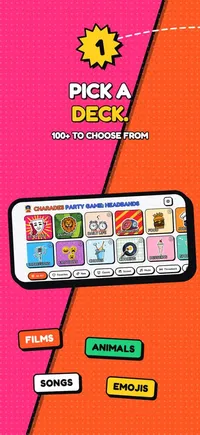
| Cards | Written slips in a bowl | Shown on a phone screen |
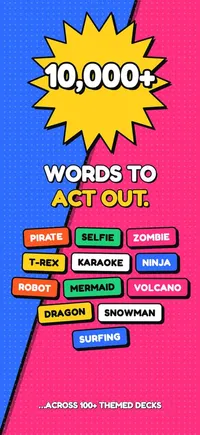
| What is guessed | Mostly titles | Any word from a themed deck |
| Speed | One title per turn | As many words as possible in a timed round |
| Scoring | A point per title | Tilt the phone to score or pass |
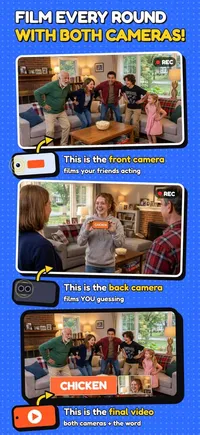
The phone format is sometimes called forehead charades. Our article on forehead charades explains how it works. In Act Up!, for example, the player holds the phone to their forehead while friends act out the card, then tilts to score or pass, and rounds can be recorded to watch back afterwards.
Why is charades still so popular?
Charades has lasted for centuries because it needs almost nothing and works for almost everyone:
- No equipment: paper and a pen, or nothing at all if you make up words on the spot.
- Any age: toddlers can act a dog, while adults tackle film titles and idioms.
- Any size of group: from three people on a sofa to a whole classroom.
- It is funny: watching someone you know try to act out a washing machine is hard to beat.
- It works anywhere: living rooms, campsites, road trips and video calls.
Whether you play the parlour version with slips of paper or the fast phone version, the heart of the game is the same: act it out, stay silent and make your team laugh while they guess.