How Many Players for Charades? Group Size Explained
How many players for charades? You need at least three: one to act and two to guess. The best group size is six to ten people split into two teams, so everyone gets plenty of turns. Two people can play a cooperative version, and big groups of 17 or more work well split into three or four teams, or with a team-acting variant like reverse charades.
What is the minimum number of players for charades?
Three is the practical minimum for a proper game. With three players:
- One person acts and the other two race to guess.
- Whoever guesses correctly scores a point and acts next.
- There are no teams, so it plays like a friendly free-for-all.
With four players you can split into two teams of two, which is the smallest version of classic team charades. Each team has one actor and one guesser per turn, and you swap roles every round.
Can two people play charades?
Yes, but it changes from a competition into a cooperative challenge. One person acts while the other guesses, and together you try to beat your own score in a set time, say two minutes. Then you swap roles and try to beat it again.
It works well for couples, siblings, roommates, or a parent playing with a child. Short action cards like “Flipping a pancake”, “Texting” or “Blowing up a balloon” from the Act It Out deck are ideal, because they keep turns quick. Our guide on charades for two has more scoring ideas and the best categories for pairs.
How many players for charades is ideal?
Here is how charades plays at different sizes:
| Players | Best setup | How it feels |
|---|---|---|
| 2 | Cooperative, beat your own score | Relaxed, quick turns |
| 3 | No teams, guesser acts next | Casual and fast |
| 4 to 5 | Two small teams | Everyone acts a lot |
| 6 to 10 | Two teams of 3 to 5 | The sweet spot: lively and fair |
| 11 to 16 | Two big teams or three teams | Loud and fun, longer waits |
| 17 or more | Three or four teams, or team acting | Party mode |
Six to ten people is the classic family games night or dinner party size, and it is where charades shines. There are enough guessers to shout lots of answers, and nobody waits too long to act.
How do you split teams fairly?
Uneven teams are the most common source of games night arguments. A few ways to keep it fair:
- Count off around the room (“one, two, one, two”) so couples and best friends are split up.
- Balance ages: put a grandparent, a parent and a child on each side when you play with family.
- Balance confident actors: if two people are known show-offs, put them on opposite teams.
- Odd numbers are fine: give both teams the same number of turns, so one player on the smaller team acts twice per round.
- Swap teams halfway through a long game to mix things up.
There are more ways to set up teams and keep score in our guide to scoring and teams.
How do you play charades with a big group?
Large groups at holiday gatherings, classrooms or office parties need a little more structure:
- Three or four teams: keeps waiting time down, and teams take turns in rotation.
- A host: one person holds the cards, keeps time and settles disputes.
- Shorter turns: 60 to 90 seconds keeps the game moving when there are many teams.
- Team acting: in reverse charades, a whole team acts together while one player guesses, which gets everyone off the sofa at once.
- Guess quietly: for very big groups, only the actor’s team may guess; other teams who shout lose a point.
How many players do you need for phone charades?
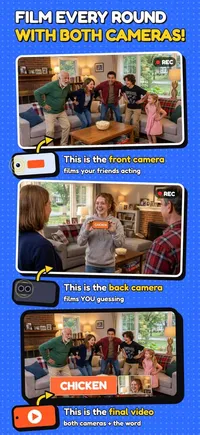
The phone-on-the-forehead version follows the same numbers. One player holds the phone to their forehead and guesses, while everyone else acts out the word on screen. With three players you get two actors working together, which is often funnier than one. With six or more, split into teams and pass the phone between them, so each team has its own timed round and its own score.
The bigger the group, the louder this version gets, because a whole room acting “gorilla” or “washing machine” at once is hard to ignore. It is a great choice when you want everyone involved in every turn rather than watching one actor.
Does group size change which words you should use?
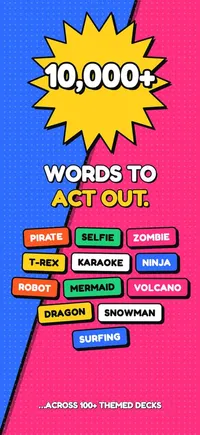
A little. Small groups and pairs do best with quick, simple cards so the pace stays high. Bigger groups enjoy harder cards, because more guessers means more chances to crack a tricky one.
Emotions are a good test of any group size. Easy feelings like happy, tired, shy and angry suit two to four players, while larger groups can tackle harder words like nostalgic, overwhelmed or mortified from the Emotions deck.
Whatever your numbers, the rule is the same: make sure everyone gets to act at least once, and keep the teams close enough that the last round still matters.