Can You Talk or Make Sounds in Charades? The Rules on Noises
Can you talk or make sounds in charades? Not in the classic game. The actor must stay completely silent: no words, no mouthing, no noises, no humming and no sound effects. Gestures, facial expressions, hand signals and nods are all fair, and the guessers can talk as much as they like. Many families allow noises for young kids, and sound-it-out rounds use sounds on purpose.
What does the actor have to avoid?
Under the standard rules, the actor must not:
- Speak any words, including “yes”, “no” or “close”.
- Mouth words silently, or lip-sync lyrics.
- Make sounds, such as animal noises, humming, whistling, clapping out a rhythm or sound effects.
- Spell words in the air or with their fingers.
- Point at objects in the room that give away the answer, such as pointing at the TV for “television”.
- Write anything down or show letters on a phone.
Breaking these rules is usually a foul, and the turn ends with no point.
What can the actor do?
Everything else is fair game. Charades is about silent communication, so the actor should use their whole body:
| Allowed | Example |
|---|---|
| Hand signals | Crank a film camera for “movie”, hold up fingers for the number of words |
| Facial expressions | Wide-eyed shock, a huge grin, a frown |
| Nodding and shaking your head | Nod hard when a guess is close |
| Pointing at a guesser | Point at the person who said the right word |
| “Sounds like” | Tug your ear, then act a rhyming word |
| Miming objects | Hold an invisible guitar, phone or umbrella |
Our guide to charades hand signals has the full set of gestures, from “little word” to “on the nose”.
Can you talk in charades if you are guessing?
Yes, and they should. Guessers can shout out as many answers as they like, ask the actor yes-or-no questions (the actor answers with a nod or shake), and talk to each other to build on half-right guesses. The other team, however, should stay quiet during your turn. If they shout answers, many groups award the point to the acting team.
The phone-on-the-forehead version works slightly differently. There, the player holding the phone is the guesser, and everyone else acts out the word on screen. The same silence rule usually applies to the actors, but some groups play a looser round where friends may describe the word without saying it. Pick one style per round and stick to it, because mixing them is the quickest route to an argument.
Can you make sounds or noises in charades?
In classic charades, no. A bark, a beep, a whistle or a hummed tune all count as sounds, and sounds are clues the guessers hear rather than see. That is why the strict rule bans them along with words. But there are three common situations where families relax the rule:
- Young children: for toddlers and preschoolers, letting them bark like a dog or roar like a lion makes the game fun rather than frustrating.
- Music rounds: some groups allow humming for song titles, but no words.
- Sound-it-out rounds: a variant where the actor must make the sound and is allowed to move as well.
Whatever you decide, agree on it before the first turn so nobody argues mid-game. A good test: if a sound gives the answer away on its own, like a barking noise for “dog”, it belongs in a kids’ round or a sound-it-out round, not a competitive adult game.
What is a sound-it-out round?
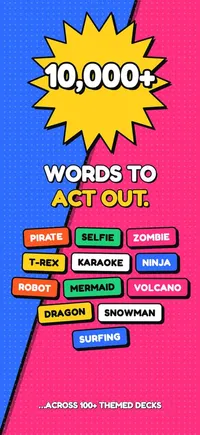
Sound-it-out flips the usual rule: instead of staying silent, the actor makes sounds, with no words allowed. It is a great change of pace in the middle of a long games night. Cards from the Sound It Out deck include:
| Easy | Medium | Hard |
|---|---|---|
| Dog Barking | Slurping Soup | Wind Chimes |
| Pig Oinking | Boiling Water | Squeaky Hinge |
| Vacuum Cleaner | Skateboard Rolling | Tornado Roar |
| Helicopter Whirring | Magic Wand Whoosh | Radio Tuning |
| Tire Screech | Whale Song | Tuning Fork |
Then go back to silent rounds with cards from the Act It Out deck, like “Flipping a pancake” or “Squeezing onto a packed bus”, and see who can stop themselves making noises.
How do you handle someone who talks by accident?
It happens to everyone, especially when a teammate is so close to the answer. A fair system:
- A stray noise (a gasp, a laugh, a “hmm”): a warning, and the turn carries on.
- Real word spoken: the turn ends, no point.
- Giving away the answer: the other team can steal the point with one guess.
Go easy on younger players. Children often blurt out a word without thinking, and a gentle reminder works far better than a penalty. For mixed-age games, it is fair to give kids a free slip or two while holding adults to the strict rule.
For more on disputes and fouls, see the full charades rules.
Is there a game like charades where you can talk?
Yes, if your group wants words in the mix. Two easy options:
- Forehead charades: the guesser holds a phone to their forehead and friends act or describe the word on screen without saying it. Our guide to forehead charades covers the house rules for talking rounds.
- Describe-it rounds: the clue-giver talks freely but may not say the word, any part of it or “sounds like” rhymes. It is a good warm-up for groups who find silent acting hard.
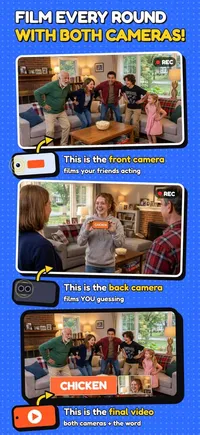
In the Act Up app you can play any deck in a talking round: just agree the rule before the timer starts.
Quick summary of the talking rules
| Who | Talk? | Sounds? | Gestures? |
|---|---|---|---|
| Actor (classic) | No | No | Yes |
| Actor (kids house rule) | No | Animal and simple noises | Yes |
| Actor (sound-it-out round) | No | Yes | Yes |
| Guessing team | Yes | Yes | Yes |
| Other team | Should stay quiet | No | No |
Keep it silent, keep it physical, and the game stays fair for everyone.